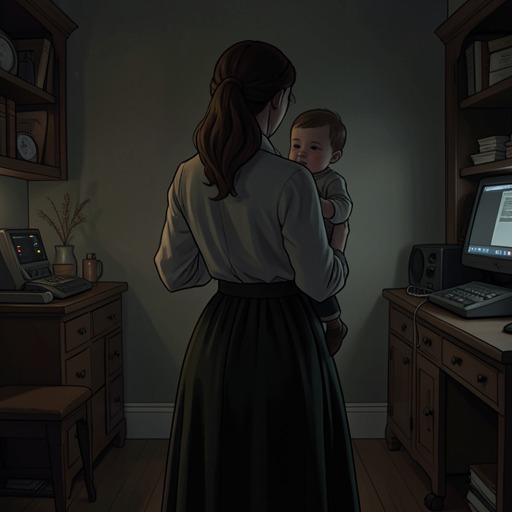
Emma Valentine flees Washington Heights
The ChangelingEmma Valentine flees Washington Heights and leaves Manhattan by water taxi, an escape Apollo Kagwa pieces together from physical evidence and discontinuous surveillance footage. The route ends at South Street Seaport, where Kim Valentine embraces Emma, presents the passes that allow them to board, and helps her depart. For Apollo, the escape is not only a disappearance but a rupture in his trust: he recognizes the woman beside Emma as Kim, whom he had seen in Chinatown that morning and given a ten-thousand-dollar check.
The Bedroom and the Evidence
When Apollo enters Brian’s bedroom, the police sticker on the door has to be cut through, and the room still bears the marks of the investigation. A board replaces the broken window opening onto the fire escape. The window is a crucial part of Emma’s exit: Fabian found the security gate open and the window smashed after seeing the baby but before calling the police. The glass lay on the sill and fire escape rather than inside the room, consistent with someone leaving through the opening.
That evidence establishes a route out, but not a route in. The front door had been locked, Emma had no keys, and no one could explain how she had entered that morning. The police forensic team collected the glass hoping to find blood; blood was present and identified as Emma’s. Its significance is limited but precise: it corroborates her contact with the broken window, without explaining the unexplained entry or resolving how she reached the bedroom.
The room’s damaged window thus gives the flight a material trace while preserving a central uncertainty. The evidence can support the conclusion that Emma escaped by way of the fire escape, but it cannot make her arrival intelligible. That gap matters: the investigation leaves Apollo with signs of Emma’s passage, not a complete account of her movements or means.
A Route Reconstructed from Fragments
Apollo follows Emma’s path through recordings assembled from multiple cameras. When one camera loses her, another takes over from a different angle farther down the block. The footage is not continuous: at times Emma has left one frame before entering the next, and the cuts were put together by William Wheeler and his many associates. The gaps make the sequence feel less like a seamless record than an incomplete pursuit, as if Apollo were following Emma through the city in the present. Only the timestamps insist that the images are old.
The footage carries her from downtown New York City toward open water. Apollo recognizes South Street Seaport and Pier 16, where the New York Water Taxi runs. The destination is personally charged: it was the site of the last date night when Apollo and Emma were a happy couple, and Apollo had taken her there. That familiar memory gives him a possible explanation for her choice of pier and for her knowledge that a late-night departure was available. It does not establish when she planned the escape, or how she obtained the means to make it.
Apollo measures the practical threshold of departure as thirty dollars for an access pass: a small price set against the consequence of vanishing from Manhattan. The contrast makes the escape seem both startlingly accessible and emotionally immense. Yet the footage does not show Emma arranging every part of it. It shows her waiting among tourists and young adults in a crowd, at the point where the route out of the city is about to become visible.
Kim’s Intervention
A woman emerges from the crowd and walks directly to Emma, putting her arms around her. Emma remains stiff during the embrace. When the water taxi arrives, the woman lets go, leads Emma to the end of the long line, and waits with her until they reach the boat. She displays two passes, and the pair board together. The recording makes the assistance concrete: Kim is not merely present at the pier but supplies the passes and accompanies Emma onto the taxi.
Apollo recognizes Kim. He had been with her in Chinatown that same morning and had given her a check for ten thousand dollars. The footage does not explain whether that money paid for the passes or what Kim intended to do with the check; it establishes the stark proximity between Apollo’s recent act of financial trust and Kim’s role in Emma’s departure. The embrace is also not evidence of easy reconciliation: Emma’s stiffness remains visible even as Kim helps her leave.
Patrice Green and Dana Green recognize Kim as well. Neither looks at Apollo; both lower their heads. Their reaction does not explain what they knew beforehand, but it marks the discovery as painful in the room where the footage is being watched. Apollo sees the water taxi pull away, and the image joins Emma’s disappearance to his recognition of the person who facilitated it. He then takes out his phone and texts William Wheeler.
Consequences and Narrative Significance
The flight is disclosed in two kinds of evidence: the broken window and blood locate Emma’s passage from the bedroom, while the camera recordings trace her to a boat leaving Manhattan. Neither offers an uninterrupted account. The forensic findings corroborate contact with the window but leave her entry unexplained; the surveillance edits show successive glimpses but leave gaps between them. The escape is therefore reconstructed rather than fully witnessed, and Apollo’s understanding arrives through fragments that answer some questions while sharpening others.
The scene’s decisive reversal is relational. Apollo follows the footage expecting to learn where Emma went; instead, he discovers that Kim helped her go. The last date-night location makes the pier a remnant of Apollo and Emma’s former intimacy, while Kim’s passes turn that shared geography into an exit. Emma’s departure becomes a separation from Manhattan and, in the act of watching, a new separation between Apollo and the people beside him. The water taxi’s departure confirms that the escape has succeeded; Apollo’s recognition of Kim gives that success its immediate personal cost.